
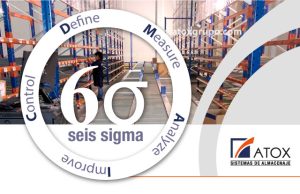
“Six Sigma” is a management strategy that pursues maximum effectiveness with maximum efficiency, based on the analysis of statistical data, the detection of the root causes of problems and the search for team solutions. Originally developed to improve the quality levels of manufacturing processes, its success and popularity has meant that the six sigma philosophy is being applied with good results also to the provision of services and to the management of the supply chain.
The origin of the “six sigma” philosophy
In the 50s and throughout the following decades, the trend to develop and implement more efficient production systems originated in Japan, with initiatives such as the just-in-time methodology, Just-in-time in English, abbreviated JIT. The awareness of reaching higher levels of quality and productivity would later also spread to the West.
In the mid-1980s, Motorola developed a management system that it called “Six sigma”, where “sigma” refers to the Greek letter σ, used in statistics to denote the standard deviation. Although other quality systems already existed at that time, one of the differences of the six sigma philosophy was the deep involvement from the beginning of those responsible for the management of the company, not only technical personnel. Although the collection of statistical data constitutes a fundamental pillar, six sigma goes further, giving great importance to a deep analysis of said data, looking for the root causes that originate the problems and then looking for the most efficient solutions. In the 1990s, General Electric adopted six sigma as its management system and, thanks to the great success achieved with it, this system would become popular throughout the world.
In the mid-1980s, Motorola developed a management system that it called “Six sigma”, where “sigma” refers to the Greek letter σ, used in statistics to denote the standard deviation. Although other quality systems already existed at that time, one of the differences of the six sigma philosophy was the deep involvement from the beginning of those responsible for the management of the company, not only technical personnel. Although the collection of statistical data constitutes a fundamental pillar, six sigma goes further, giving great importance to a deep analysis of said data, looking for the root causes that originate the problems and then looking for the most efficient solutions. In the 1990s, General Electric adopted six sigma as its management system and, thanks to the great success achieved with it, this system would become popular throughout the world.
What is “six sigma”
Sigma, σ, is the Greek letter used in statistics to denote the standard deviation. Simplifying, it indicates how much a data set varies with respect to its arithmetic mean.
In the context of the six sigma management system, an expected value would be a product manufactured with the correct measurements and variability would refer to how many products have resulted with measurements higher or lower than expected, exceeding the allowed tolerances. This can also apply to service delivery or supply chain management.
Suppose that the six sigma system is being implemented in the management of a warehouse and the sigma performance of the order preparation process had to be calculated. The preparation of an order would be a “unit“. Then, an order could be considered defective for various reasons: because it was prepared incompletely, because it included the wrong merchandise, because it was sent to the wrong recipient, or because it was prepared in an excessive amount of time. Each of these possible causes of defect is called an “opportunity“. Although one could calculate the sigma for each of these causes separately, they can also be combined by calculating defects per million opportunities (DPMO), sometimes called the mother sigma:
In the context of the six sigma management system, an expected value would be a product manufactured with the correct measurements and variability would refer to how many products have resulted with measurements higher or lower than expected, exceeding the allowed tolerances. This can also apply to service delivery or supply chain management.
Suppose that the six sigma system is being implemented in the management of a warehouse and the sigma performance of the order preparation process had to be calculated. The preparation of an order would be a “unit“. Then, an order could be considered defective for various reasons: because it was prepared incompletely, because it included the wrong merchandise, because it was sent to the wrong recipient, or because it was prepared in an excessive amount of time. Each of these possible causes of defect is called an “opportunity“. Although one could calculate the sigma for each of these causes separately, they can also be combined by calculating defects per million opportunities (DPMO), sometimes called the mother sigma:
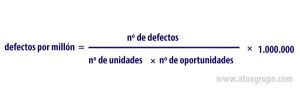
If we had collected data from 1,000 orders and found 26 defective orders, taking into account that in our example we were considering 4 possible causes of incorrect orders (4 opportunities), our value of defects per million would be:

With 6,500 defects per million, the performance would be below 4 sigma, according to the following table:

The six sigma system owes its name to the fact that it seeks to achieve a performance of 6σ, that is, only 3.4 defects per million, or what, in the system’s terminology, can also be expressed as only 3.4 bad experiences of customers per million opportunities. Although it may seem like a very ambitious goal, many of the companies that have successfully implemented the six sigma system have been able to push their performance above 5 sigma.
Business process management
The implementation of six sigma in a company begins with the active involvement of the company’s management and its executives. They must adopt a management philosophy based on business processes, oriented towards quality and customer satisfaction.
A business process is a set of activities that receive input, add value, and produce output for another process. For example, in the management of a warehouse, a process would be the processing of a sale through an online store or by phone. Your entry would be a purchase order and the process would be divided into several steps such as: checking the payment, checking the availability of the merchandise and confirming the order. The output would be an order. This purchase order would in turn be the input for another process: order preparation, whose steps would be the receipt of the purchase order, the collection of the merchandise by means of picking, the packaging, the labeling with the destination address and its accumulation in the dispatch area for transport.
As an initial phase in the adoption of the six sigma system, the key processes for the company would be identified and their current performances (their sigma levels) would be measured. Of all of them, those processes with the lowest performance but the greatest impact could represent for the company would be chosen as the first to optimize.
A business process is a set of activities that receive input, add value, and produce output for another process. For example, in the management of a warehouse, a process would be the processing of a sale through an online store or by phone. Your entry would be a purchase order and the process would be divided into several steps such as: checking the payment, checking the availability of the merchandise and confirming the order. The output would be an order. This purchase order would in turn be the input for another process: order preparation, whose steps would be the receipt of the purchase order, the collection of the merchandise by means of picking, the packaging, the labeling with the destination address and its accumulation in the dispatch area for transport.
As an initial phase in the adoption of the six sigma system, the key processes for the company would be identified and their current performances (their sigma levels) would be measured. Of all of them, those processes with the lowest performance but the greatest impact could represent for the company would be chosen as the first to optimize.
Effectiveness and efficiency
One of the fundamental principles of the six sigma philosophy is to introduce improvements while pursuing effectiveness and efficiency at the same time.
Let’s take, for example, a warehouse for non-perishable products, with a low level of turnover. Due to their needs, compact shelving was installed. Over time, the business grows and, as a consequence, the need arises to store a greater quantity of merchandise and increase the number of references with which it works. In addition, with the increased workload, maneuvering with forklifts in the drive-in racks begins to penalize performance.
With a classic management philosophy, you might consider that the time has come to move to a larger warehouse and migrate from drive-in racking to pallet racking. While this would be an effective solution to the problems posed, it would not be efficient as the proportion of resources required would decrease profitability and would require more than twice the space.
With a more modern philosophy, on the other hand, it would be analyzed that the turnover level is still low and that the new needs would be covered if the depth level of the drive-in racks could be increased, handle a greater number of SKUs and streamline operations with forklifts. forklifts So, the solution is to install the ATOX SHERPA 800 radio shuttle system. With radio shuttles, also called pallet shuttles or pallet transporters, drive-in racks can be as deep as necessary, a different reference can be handled per level and not just per module, and forklift operations are now agile and safe.
Let’s take, for example, a warehouse for non-perishable products, with a low level of turnover. Due to their needs, compact shelving was installed. Over time, the business grows and, as a consequence, the need arises to store a greater quantity of merchandise and increase the number of references with which it works. In addition, with the increased workload, maneuvering with forklifts in the drive-in racks begins to penalize performance.
With a classic management philosophy, you might consider that the time has come to move to a larger warehouse and migrate from drive-in racking to pallet racking. While this would be an effective solution to the problems posed, it would not be efficient as the proportion of resources required would decrease profitability and would require more than twice the space.
With a more modern philosophy, on the other hand, it would be analyzed that the turnover level is still low and that the new needs would be covered if the depth level of the drive-in racks could be increased, handle a greater number of SKUs and streamline operations with forklifts. forklifts So, the solution is to install the ATOX SHERPA 800 radio shuttle system. With radio shuttles, also called pallet shuttles or pallet transporters, drive-in racks can be as deep as necessary, a different reference can be handled per level and not just per module, and forklift operations are now agile and safe.
DMAIC enhancement method
To improve processes, the DMAIC method is followed, an acronym in English for its five phases: Define, Measure, Analyze, Improve and Control (in Spanish: Define, Measure, Analyze, Improve and Control).
Suppose that in the management of a warehouse for a Online store customer requirements have been defined or CTQs (acronym for Critical to Quality) and one of them was the preparation of orders in a very agile way as soon as the order orders are received and keeping the inventory synchronized. In this same definition phase, the business processes would be considered and the steps of which they are composed would be detailed (in our example, the preparation of an order).
Then the process would be measured, taking data on the orders that have been correctly prepared, the incorrect orders and for what reasons, and the delayed orders and their reasons.
During data analysis, Pareto diagrams are often used, directly related to the 80-20 rule or Pareto principle, which basically says that 20% of something is usually responsible for 80% of the results. This means that most likely a small portion of the causes that can influence order fulfillment (20%) would be responsible for the majority of late or incorrect orders (80%). These causes with the greatest impact would be the first targets for improvement.
The analyzes are carried out in depth, trying to identify the root causes of the problems, beyond the causes that may seem more obvious at first.
In our example, the cause at a superficial level might seem to be the poor performance of the warehouse staff, but a deeper analysis could reveal that the true causes are that the operators have to make inefficient routes during picking, delaying order preparation. . The analysis could also have revealed that, since a good part of the business model of this online store is based on the long tail, a great diversity of SKUs is handled with few units, so warehouse staff cannot become used to quickly locating each SKU on the metal racks. And so the conclusion is reached that the root of the problem is the inefficiency of the method with which the orders are prepared, which forces to work with inefficiency. The demands of the times then make the warehouse staff work with more pressure and make more picking errors.
Once the root cause of the problem has been identified, improvement solutions are proposed seeking effectiveness and efficiency at the same time.
A planning with a traditional philosophy in our example would be to demand more from the warehouse personnel, pretending that they work faster, but about inefficiency, which would only aggravate the problem. Or, assigning more warehouse personnel to order preparation to the detriment of other processes such as reverse logistics operations, merchandise replacement, etc., which, again, would worsen the problem in the medium term.
On the other hand, with a six sigma philosophy, several solutions would be proposed and refined until the one that solved the problem effectively but presented the greatest efficiency and, with it, the greatest profitability for the business, was left.
In our example, a change in the order preparation method would have been considered. Instead of assigning a single order to each warehouse staff, to fully prepare it, each operator would be assigned an area of the warehouse and would work only in that one. To do this, the ATOX light-guided system for pick-to-light operations combined with the intelligent roller transport system would be installed in the warehouse. In this way, several operators would collaborate in the preparation of the same order without having to leave their post. With the pick-to-light assistance, the operators would require less concentration during picking and would be guided directly to the appropriate shelf, so handling a wide variety of SKUs would not affect their performance.
Suppose that in the management of a warehouse for a Online store customer requirements have been defined or CTQs (acronym for Critical to Quality) and one of them was the preparation of orders in a very agile way as soon as the order orders are received and keeping the inventory synchronized. In this same definition phase, the business processes would be considered and the steps of which they are composed would be detailed (in our example, the preparation of an order).
Then the process would be measured, taking data on the orders that have been correctly prepared, the incorrect orders and for what reasons, and the delayed orders and their reasons.
During data analysis, Pareto diagrams are often used, directly related to the 80-20 rule or Pareto principle, which basically says that 20% of something is usually responsible for 80% of the results. This means that most likely a small portion of the causes that can influence order fulfillment (20%) would be responsible for the majority of late or incorrect orders (80%). These causes with the greatest impact would be the first targets for improvement.
The analyzes are carried out in depth, trying to identify the root causes of the problems, beyond the causes that may seem more obvious at first.
In our example, the cause at a superficial level might seem to be the poor performance of the warehouse staff, but a deeper analysis could reveal that the true causes are that the operators have to make inefficient routes during picking, delaying order preparation. . The analysis could also have revealed that, since a good part of the business model of this online store is based on the long tail, a great diversity of SKUs is handled with few units, so warehouse staff cannot become used to quickly locating each SKU on the metal racks. And so the conclusion is reached that the root of the problem is the inefficiency of the method with which the orders are prepared, which forces to work with inefficiency. The demands of the times then make the warehouse staff work with more pressure and make more picking errors.
Once the root cause of the problem has been identified, improvement solutions are proposed seeking effectiveness and efficiency at the same time.
A planning with a traditional philosophy in our example would be to demand more from the warehouse personnel, pretending that they work faster, but about inefficiency, which would only aggravate the problem. Or, assigning more warehouse personnel to order preparation to the detriment of other processes such as reverse logistics operations, merchandise replacement, etc., which, again, would worsen the problem in the medium term.
On the other hand, with a six sigma philosophy, several solutions would be proposed and refined until the one that solved the problem effectively but presented the greatest efficiency and, with it, the greatest profitability for the business, was left.
In our example, a change in the order preparation method would have been considered. Instead of assigning a single order to each warehouse staff, to fully prepare it, each operator would be assigned an area of the warehouse and would work only in that one. To do this, the ATOX light-guided system for pick-to-light operations combined with the intelligent roller transport system would be installed in the warehouse. In this way, several operators would collaborate in the preparation of the same order without having to leave their post. With the pick-to-light assistance, the operators would require less concentration during picking and would be guided directly to the appropriate shelf, so handling a wide variety of SKUs would not affect their performance.
Effective and efficient warehouses
ATOX Storage Systems designs and manufactures high-quality metal racking systems to optimize warehouse space. ATOX Soluciones Tecnológicas automation systems are added to the wide range of storage systems to optimize performance in maintenance operations.
ATOX designs its systems according to its clients. With more than 50 years of experience and a wide international presence, ATOX has improved the performance and profitability of warehouses of all sizes and business sectors in various countries around the world.
ATOX designs its systems according to its clients. With more than 50 years of experience and a wide international presence, ATOX has improved the performance and profitability of warehouses of all sizes and business sectors in various countries around the world.