

In today’s logistics industry, where efficiency and optimization of goods flows are key factors in the competitiveness of any company, the roller conveyor system plays an essential role. It is a key element in ensuring that products, packages, and pallets can move safely, efficiently, and continuously through storage facilities and distribution centers. However, there are different types of conveyor rollers, and it is important to recognize the difference between each one.
So, in this article, we will explore in depth what these rollers are, what they are used for, and above all,what types of conveyor rollers currently exist, along with their uses, specific characteristics, and criteria for selecting the right model for each logistics need.
What are conveyor rollers and what are they used for?
Roller conveyors are mechanical components that form the basis of most transport systems in warehouses, distribution centers, and production facilities. They are arranged in a line to create rolling surfaces on which products can move, either by gravity or by motorized systems. Thanks to these elements, goods can flow steadily and safely, reaching different areas of preparation, sorting, or packaging without the need for manual intervention at each point along the way.
The importance of these rollers in modern logistics lies in the fact that they make it possible to efficiently organize product flows, adapt to different warehouse configurations, and ensure that both light loads and heavy products can be transported at different stages of the distribution process.
Types of conveyor rollers and main features
However, it is important to note that there are several types of conveyor rollers that can be adapted to a wide variety of uses and specific needs in each logistics operation. Knowing what each one offers is crucial to selecting the most appropriate option in each case. Therefore, below we will discuss the main types:
Gravity rollers
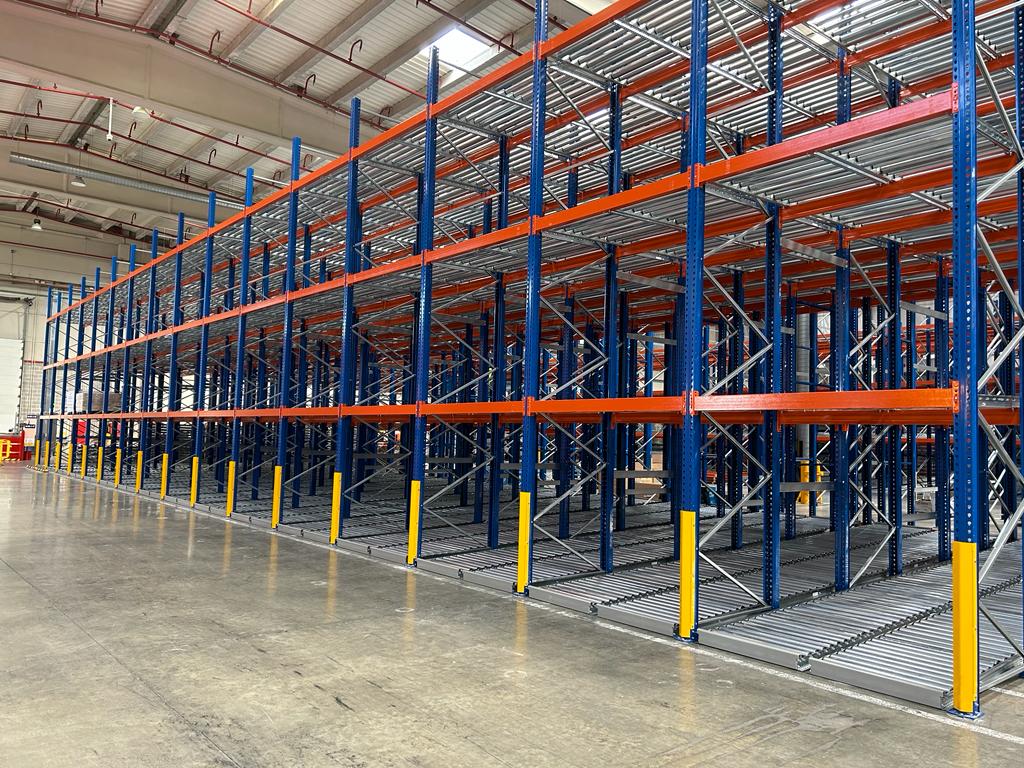
These are one of the most traditional solutions in internal warehouse logistics and on the production lines of manufacturing companies. They are used to transport loads by gravity, installed on slopes that allow products to move forward under their own weight. They are ideal for order preparation areas, where the need to reduce costs and simplify equipment is key to ensuring a continuous, uninterrupted flow.
These rollers are particularly suitable for transporting packages of different sizes and moderate weights, with the advantage of not requiring electrical power for operation. As a result, they have become a high-performance system with various industrial applications in today’s market.
Among these gravity roller solutions, we also find the Push Back system for pallet storage by accumulation, where pallets are moved by push.
2. Motorized rollers
On the other hand, motorized rollers ensure active and controlled transport, especially in facilities where speed and precision in the movement of goods are crucial. They incorporate a small motor integrated into each roller or into a section of rollers to ensure that the goods move forward in a constant and synchronized manner.
This type of roller is ideal for environments where automation and communication with other systems, such as weight scanners or sorting devices, are essential to ensure efficiency and safety in logistics operations.
3. Tapered rollers
Thirdly, there are tapered rollers, which are particularly useful in installations where it is necessary to guide goods through curves or changes of direction in the conveyor line. Thanks to their special design, these rollers allow products to follow a precise path in tight turns, ensuring that the speed of the load remains constant and that there is no unwanted lateral movement.
Their importance lies in ensuring that goods can change direction without the need for additional equipment, gaining in efficiency and adaptability to the design of specific installations, even when storage spaces are not so large.
4. Impact rollers
Impact rollers are essential components in installations where goods are subject to falls or shocks when being loaded onto the conveyor, such as when feeding conveyor belts from hoppers, loaders, or elevated discharge points. Thanks to their special coating, these rollers absorb the energy of the fall, protecting both the conveyor structure and the goods themselves.
They are mainly used in environments where robustness and durability are essential to ensure that the conveyor system operates continuously despite receiving intensive loads. For this reason, it is a type of conveyor with a high load capacity.
5. Return rollers
Finally, there are return rollers, which play a critical role in ensuring that the conveyor belt can return safely and in a controlled manner to the start of the circuit to continue transporting products. They are placed in the return section of the conveyor belt, supporting it to maintain tension and alignment.
Their importance in internal logistics lies in ensuring that the transport operation runs smoothly and continuously, preventing slippage, accumulation, or damage to the conveyor belt.
Applications of each type of roller in logistics and industry
Each type of conveyor roller offers a specific advantage in the internal logistics of warehouses and production facilities. For example, gravity rollers are used in order preparation areas where manual operation is still present, while motorized rollers are essential to ensure continuous transport in facilities that work with automated storage.
Conical rollers are vital in facilities where goods are distributed in different directions, and impact rollers ensure that loading operations run smoothly and without breakdowns in demanding environments. This variety of options makes it possible to design facilities tailored to every need, achieving higher levels of efficiency, safety, and adaptability in different logistics and industrial contexts.
Criteria for selecting the right conveyor roller for your warehouse
The selection of a conveyor roller should not be based solely on economic criteria, but on a technical analysis of the specific characteristics of each operation. It is essential to consider key aspects such as the weight of the loads to be transported, the desired operating speed, the need to change direction on the conveyor line, and the intensity of daily operation.
It is also important to assess other factors, such as the type of products to be transported, the need to ensure continuous and synchronized movement, or the availability of power to drive motorized rollers. Consulting with logistics solution experts ensures that each company can invest in the most appropriate conveyor system to guarantee efficiency and safety in all processes.
Benefits of investing in quality conveyor rollers for logistics efficiency
Having quality conveyor rollers provides significant advantages for any company. Not only does it guarantee a continuous and uninterrupted flow of products, but it also reduces operating costs by minimizing breakdowns and the need for frequent repairs. By investing in rollers adapted to the specific characteristics of each warehouse, the company ensures greater safety for operators and products, while increasing the productivity and efficiency of all facilities.
In addition, the durability of these components helps to ensure a long-term return on investment, strengthening logistics operations and increasing the company’s competitiveness in a market where speed and reliability make all the difference.
Conclusion
Without a doubt, the different types of conveyor rollers can be differentiated from each other thanks to their unique characteristics, allowing you, as a manufacturing or logistics company, to choose the one that best suits your long-term needs. In general, this is a system whose use implies a great improvement in operational chains. So, if you need to find the conveyor roller system that best suits your needs, at Grupo ATOX we are here to help you with this.