
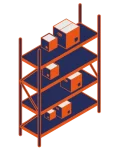
According to statistics, more than 50% of the operating costs of a warehouse correspond to the preparation of orders. In addition, during the preparation of an order, more than 50% of the time is spent on unproductive trips. With these figures, it is clear why optimizing picking is one of the priorities in the design and management of a warehouse. Added to this is that, unlike conventional warehouses, modern supply chains have to deal with the added complexities of today’s market volatility, the demands of e-commerce, long-tail-based business models, or longtail, etc.
In this article we explain what “product slotting” is, the main strategies traditionally adopted to optimize picking and how ATOX Soluciones Tecnológicas provides highly efficient modern solutions.
What is “slotting“?
“Product slotting” refers to the strategic way in which merchandise is located within a warehouse in order to improve the performance of maintenance tasks.
Although slotting seeks the best performance in various aspects of the warehouse (use of space, ease of handling, etc.), it is very common that priority is given to organizing the merchandise in such a way that picking is optimized, due to the predominant role it plays order preparation.
An appropriate slotting, or accommodation of merchandise, will have a direct and decisive impact on the performance of picking processes, reducing the distances that operators have to travel.
Each position on a shelf to store a product will be a slot. Some slots will have advantages over others. For example, slots that are closer to the picking operators will require them to travel less distance. On the other hand, slots in shelves that are higher or lower will make picking more uncomfortable and slow,
There will be “better” slots and “worse” slots and criteria must be adopted to decide which products to store in the best slots. Typically, the SKUs that have a higher turnover, that is, they appear in a greater number of order lines and, therefore, are involved in picking operations more frequently, should be in slots with easier access. But this depends on each store and each product. For example, better slots, in which picking is easier, could be assigned to those fragile, heavy or bulky products that require more delicate handling, even if these references were not so frequent.
As slotting optimization goes deeper, a greater diversity of factors to consider will appear and the complexity will grow. For example, by analyzing order history, those products that are frequently included in the same order could be placed in nearby slots.
As another example, in conventional manual picking warehouses, slotting could take into account keeping very similar products physically separate, in order to avoid confusion during picking.
The complexities of slotting in the modern supply chain
Many of the conventional picking optimization strategies and slotting criteria are based on traditional supply chain behaviors. But current times introduce greater complexities that make these strategies insufficient.
Globalized markets have led to more volatile markets, with more unpredictable fluctuations in demand and shorter product life cycles. The rise of e-commerce imposes much higher logistical demands and has meant that supply chains have to handle more frequent but lower volume orders. Market philosophies that were unthinkable years ago are now profitable, relying on modern logistics and the potential of online sales, making room for business models based on the long tail.
Motivated by all of the above, ATOX Storage Systems, with more than 50 years optimizing warehouses with its metal racking systems, has expanded its range of storage solutions with automated systems from ATOX Technological Solutions, which allow optimizing picking, reaching the maximum performance levels.
The different picking strategies
More than 50% of the time in preparing an order through manual picking is spent on trips. For this reason, different types of picking have been developed that seek to reduce the distances that warehouse operators have to travel. Some of the most representative picking strategies are explained below.
Discrete picking or “discrete picking“
Discreet picking is the simplest. A warehouse worker picks one order at a time, line by line, moving to pick each item until the order is complete. Although its advantage is simplicity, it is the most inefficient, requiring the operator to travel longer distances.
ATOX’s light-guided system drastically speeds up discreet picking by allowing orders to be prepared through pick-to-light operations. The operator is guided with head lights in the aisles and lights on each shelf during the preparation of an order so that he follows the most optimized route. In addition, the ATOX light-guided system is multi-user, assigning a light color code to each operator. In this way, several operators can be preparing different orders at the same time.
Picking by zones or “Zone picking“
Picking by zones or “Zone picking” is intended to reduce the distances that each operator must travel during order preparation. To do this, the picking area is divided into zones and a zone is assigned to each operator. In this way, each operator only moves through his area, preparing only the part of the orders that corresponds to the references in that area.
The combination of the light-guided system from ATOX Soluciones Tecnológicas with the intelligent roller transport system allows for maximum performance in zone picking. Each operator prepares parts of the orders through pick-to-light operations without leaving their post. Roller conveyors, equipped with sensors and diverters, automatically move partially satisfied orders to the next picking area that is needed or to the packaging area when the order is complete.
Batch picking or “batch picking“
Batch picking or “batch picking” seeks to make the most of each movement of warehouse operators. When an operator moves to carry out a picking operation, he takes advantage of moving to a product to pick up all the units of the same reference to cover the lines of several orders, that is, the orders are prepared in batches. Then, in another area, the units are separated again to consolidate each order.
Thanks to the automation of ATOX Technological Solutions, the highest levels of performance can be achieved in batch picking. ATOX automated warehouse systems can be integrated with any ERP or WMS system that the warehouse is using. In this way, the light-guided system allows operators to collect merchandise in batches through pick-to-light operations. Roller conveyors automatically take the merchandise to the consolidation area, where the versatility of the ATOX light-guided system allows operators to separate the merchandise and complete orders through put-to-light operations.
Automatic picking
In automatic picking, the picking process is fully automated. ATOX miniload systems and automatic dispensers allow automatic order preparation at very high speed. Its combination with intelligent roller conveyors, which incorporate sensors and sorters, allows the merchandise to be automatically transported to the packaging area, automatically classifying it according to its destination.
Take advantage of our experience
ATOX Storage Systems has more than 50 years designing and manufacturing metal shelving systems and storage solutions. With a wide international presence, ATOX has helped clients from different countries and business sectors to optimize their internal logistics, providing solutions adapted to the needs of each warehouse.
If you want to optimize your warehouse, do not hesitate to contact us for more information and advice.